
Contents
- 1 Introduction
- 2 What God Means by Peace
- 3 Why Pressure Feels So Heavy
- 4 Peace in the Middle of Responsibility
- 5 What Stress Feels Like—and How to Respond
- 6 Learning What to Carry—and What to Release
- 7 When Others Depend on You
- 8 Understanding “Don’t Be Anxious”
- 9 A Steady Way to Live
- 10 Conclusion
- 11 Frequently Asked Questions
Introduction
Some roles in life come with weight.
If you lead people, run a business, care for others, or carry responsibility that does not easily pause, you already know what that feels like managing stress. The day may end, but your thoughts often do not. Decisions follow you into the evening. Problems replay in your mind. You may even find yourself trying to solve tomorrow before it arrives.
Over time, that pressure builds.
It is not always loud. Sometimes it shows up quietly—tight thinking, a restless mind, or the feeling that you are always one step behind. Even when things are going well, there can still be a sense that everything depends on you. This often connects to a deeper struggle of learning to trust God when outcomes are uncertain, something we explore further in our guide on trusting God in uncertain times.
The Bible does not ignore this kind of life. It speaks directly into it.
God does not promise that pressure will disappear. But He does offer something that changes how you live within it. He offers His peace.
This article contains affiliate links. If you purchase through these links, JoyousBible may earn a commission at no additional cost to you. We only recommend resources that are relevant to biblical growth, Christian living, and faith-based study.
What God Means by Peace
When the Bible speaks about peace, it is not simply talking about calm situations or easy days. It is describing something deeper and more steady.
In Philippians 4:6–7, we are told not to be anxious, but instead to bring everything to God in prayer. Then it says that the peace of God will guard your heart and your thoughts.
That idea of “guarding” matters.
It means God’s peace does not just comfort you for a moment. It stands watch over your inner life. It protects your thinking when pressure tries to take over. This is especially important when anxiety begins to build, something we explore more deeply in our article on overcoming worry through faith. It steadies your heart when situations feel uncertain. This kind of peace is closely connected to learning how to rest in God, not just physically, but internally, even when life is still moving quickly.
This kind of peace does not wait until everything is solved. It begins to work while things are still unfolding.
Why Pressure Feels So Heavy
Pressure becomes stressful when it starts to feel personal.
It is one thing to complete a task. It is another thing to feel responsible for how everything turns out. When others depend on you, the weight increases. Decisions carry more meaning. Mistakes feel more costly.
Over time, your thinking can shift without you noticing. Instead of simply doing your work, you begin to carry the outcome of your work. Instead of making decisions, you begin to carry the pressure of those decisions.
You may notice thoughts like, “If I don’t get this right, it affects everything,” or “I can’t afford to miss this.” Those thoughts are not unusual. But if they stay unchecked, they begin to build a kind of pressure that is hard to turn off.
This is where stress often grows—not just from what you do, but from how much you feel you must carry.
Peace in the Middle of Responsibility
Many people believe peace comes after the pressure is gone. They think, “Once things settle down, then I’ll feel better.” But in high-pressure roles, things rarely stay settled for long.
That is why the words of Jesus are so important:
“My peace I leave with you. My peace I give to you; not as the world gives, give I to you. Don’t let your heart be troubled, neither let it be fearful.” — John 14:27 (WEB)
Jesus does not promise to remove responsibility. Instead, He offers a different way to live within it.
Peace begins when you stop trying to carry everything by yourself.
This does not mean stepping away from your role. You still show up. You still make decisions. You still take responsibility for what is in front of you. But internally, something begins to change.
You start to notice when your thinking becomes heavy. You begin to recognize the moment when responsibility turns into pressure. And instead of holding on tighter, you learn to release what was never meant to stay in your hands.
It often looks like a small shift in thought.
Instead of thinking, “Everything depends on me,” you begin to think, “I will do what I can, and trust God with the rest.”
That shift may seem simple, but it changes how pressure feels. It removes the weight of control and replaces it with trust. Over time, that is where peace begins to take root.
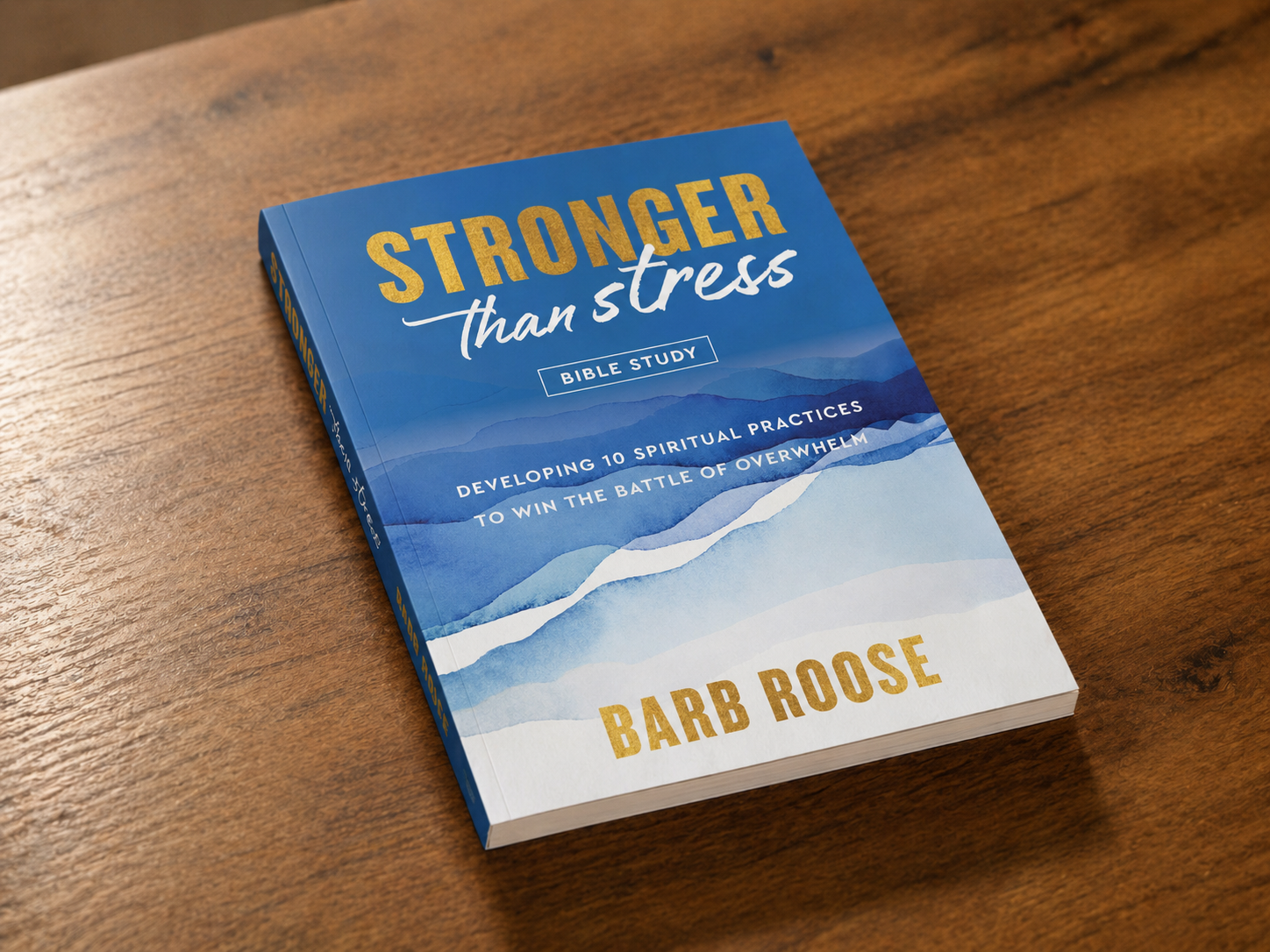
Stronger than Stress Bible Study by Barb Roose
Less stress. More peace. Strength in Christ.
Life can feel heavy when you are trying to hold everything together.
Stronger than Stress is a six-week Bible study that helps you bring stress, burnout, and overwhelm to God through Scripture, reflection, and companion video teaching.
Through Paul’s life, Barb Roose guides you toward spiritual rhythms like surrender, Sabbath, prayer, Scripture, simplicity, and self-care.
With Christ, you can begin again—with less stress, deeper peace, and strength for each day.
Check Current Price and Availability at Amazon.
What Stress Feels Like—and How to Respond
Stress rarely announces itself clearly. It shows up in subtle ways during your day.
You may notice your thoughts speeding up, moving quickly from one problem to the next. You may find yourself replaying the same situation over and over, trying to find a better outcome. Sometimes it feels like you are already behind, even if nothing has gone wrong yet.
In those moments, it is easy to stay inside the pressure.
But this is often the exact point where a small shift can make a real difference.
Instead of pushing through, you can pause.
That pause does not need to be long. It simply gives you space to step out of the cycle for a moment. As you slow down, even your breathing begins to settle. And in that space, you turn your attention toward God.
A simple, honest prayer is enough. Something like, “Lord, this feels heavy. I need Your help.”
That kind of moment may seem small, but it changes direction. It moves you from carrying everything alone to inviting God into what you are facing.
The situation may not change right away, but your experience of it begins to shift. The pressure loosens, even if just a little. And that is often how peace starts—quietly, in the middle of the moment.
Learning What to Carry—and What to Release
One of the most important parts of managing stress is understanding what belongs to you and what does not.
You are responsible for your actions. You are responsible for showing up, making decisions, and doing what is right with what you have been given.
But you are not responsible for every outcome.
This is where many people begin to carry more than they were meant to. They take on results that are outside their control. They try to manage how everything turns out, even when there are too many factors to hold together.
In Proverbs 3:5, we are told to trust in God rather than lean fully on our own understanding. That does not mean ignoring wisdom or effort. It means recognizing that your perspective is limited, and that God sees more than you do.
As you begin to separate what you can control from what you cannot, something important happens. The pressure begins to lift. Not because responsibility disappears, but because it becomes clearer.
You do what is yours to do and you release what is not. Letting go of outcomes is not always easy, but it becomes more natural as you grow in trusting God through difficult situations.
| Principle | Bible Quote | Marketplace Application |
|---|---|---|
| Peace comes from God’s presence, not perfect conditions | “Don’t be anxious about anything… the peace of God… will guard your hearts and your thoughts in Christ Jesus.” Philippians 4:6–7 WEB |
When pressure builds during the day, pause and bring the situation to God instead of trying to solve everything at once. |
| Peace is given, not earned through control | “My peace I leave with you… Don’t let your heart be troubled…” John 14:27 WEB |
When you feel everything depends on you, remember that peace comes from trusting God while you faithfully do your part. |
| Trust God beyond your own understanding | “Trust in Yahweh with all your heart, and don’t lean on your own understanding.” Proverbs 3:5 WEB |
When decisions feel overwhelming, focus on taking the next right step instead of trying to predict every outcome. |
| Commit your work and leadership to God | “Commit your way to Yahweh. Trust also in him…” Psalm 37:5 WEB |
Before major decisions or meetings, take a moment to commit the situation to God and release the weight of control. |
| God cares about what you carry | “Cast all your worries on him, because he cares for you.” 1 Peter 5:7 WEB |
Instead of holding stress internally, release concerns through short, honest prayers during the day. |
| Peace begins in your thinking | “Whatever things are true… think about these things.” Philippians 4:8 WEB |
When your mind replays worst-case scenarios, redirect your thoughts toward what is true instead of what might go wrong. |
| God provides rest for the burdened | “Come to me… and I will give you rest.” Matthew 11:28 WEB |
Build short pauses into your day to reset and reconnect with God instead of pushing through exhaustion. |
| God is present in every situation | “Yahweh is my shepherd: I shall lack nothing.” Psalm 23:1 WEB |
When stress feels overwhelming, remember that you are not alone in your work or responsibility. |
When Others Depend on You
Pressure often feels strongest when other people are involved.
When others depend on your decisions, it can feel like you always need to have the right answer. You may feel like there is no room for mistakes, or that every choice carries more weight than it should.
This is where stress can become deeply personal.
But Scripture offers a different way to carry that responsibility.
“Commit your way to Yahweh. Trust also in him, and he will do this.” — Psalms 37:5 (WEB)
To commit your way to God means you are not leading on your own. You are walking with Him as you make decisions.
You still care about the outcome. You still want to do well. But you are no longer trying to control everything that happens next.
Faithful leadership is not about being perfect. It is about being steady, honest, and willing to trust God as you move forward.
Understanding “Don’t Be Anxious”
Sometimes it helps to look at Scripture from another angle.
In Philippians 4:6, the WEB translation says, “Don’t be anxious about anything,” while the NLT says, “Don’t worry about anything.”
Both expressions point to the same issue, but they highlight different parts of it.
“Worry” is often what we notice first. It shows up in our thoughts as we go over problems again and again. “Anxiety” runs deeper. It is the ongoing sense of tension that can sit underneath those thoughts.
God is speaking to both.
He is not simply asking you to stop thinking about your problems. He is inviting you to bring those thoughts to Him, so they no longer take control of your mind.
A Steady Way to Live
Peace does not usually come all at once. It grows through small, steady moments of turning back to God.
It might begin in the morning, when you take a moment to place your day in His hands. It may continue in the middle of a busy afternoon, when you pause instead of pushing harder. And it often shows up in the evening, when you choose to release what you carried instead of holding onto it overnight.
These moments may seem small, but over time they begin to shape how you live.
You become less reactive.
More steady.
Less burdened by what you cannot control.
And more aware that you are not carrying your life alone.
Conclusion
High-pressure roles are not going away. Responsibility will always be part of life.
But the weight of that responsibility does not have to stay on you.
God does not ask you to remove pressure from your life. He invites you to walk with Him in the middle of it. As you learn to bring your thoughts to Him, release what you cannot control, and trust Him with what lies ahead, something begins to change.
Peace does not replace responsibility, but it changes how responsibility feels.
And over time, that quiet, steady peace becomes something you can live in—even when the pressure remains.
Frequently Asked Questions
Is stress always a sign that something is wrong spiritually?
No, stress is not always a sign of weak faith or spiritual failure. Many high-pressure roles naturally come with responsibility and weight. Even in the Bible, we see faithful people facing intense pressure.
The key difference is not whether stress exists, but how you respond to it. God invites you to bring that stress to Him rather than carry it alone.
How can I stay peaceful when I still have difficult decisions to make?
Peace does not mean the absence of difficult decisions. It means making those decisions while trusting God.
“Trust in Yahweh with all your heart…” — Proverbs 3:5 (WEB)
You can move forward step by step, knowing that God is guiding you—even when the outcome is not fully clear.
What should I do when stress keeps returning throughout the day?
Recurring stress is normal, especially in demanding roles. Instead of trying to eliminate it completely, build a habit of returning to God repeatedly. Short moments of prayer throughout the day can reset your thoughts and restore peace. This is not about doing it perfectly, but about staying connected.
How do I know what to trust God with and what I am responsible for?
A helpful way to think about this is a clear separation of roles:
- You are responsible for your actions, decisions, and obedience.
- God is responsible for outcomes and results.
“Commit your way to Yahweh. Trust also in him…” — Psalms 37:5 (WEB)
When you clearly separate these two, much of the pressure begins to lift.
Can I really experience peace if my situation does not change?
Yes. Biblical peace is not based on circumstances improving. It is based on God’s presence.
“The peace of God, which surpasses all understanding…” — Philippians 4:7 (WEB)
This means you can experience real peace even in ongoing pressure, because it comes from God—not from your situation.
If you have enjoyed this post, perhaps you would like one of our other Posts.