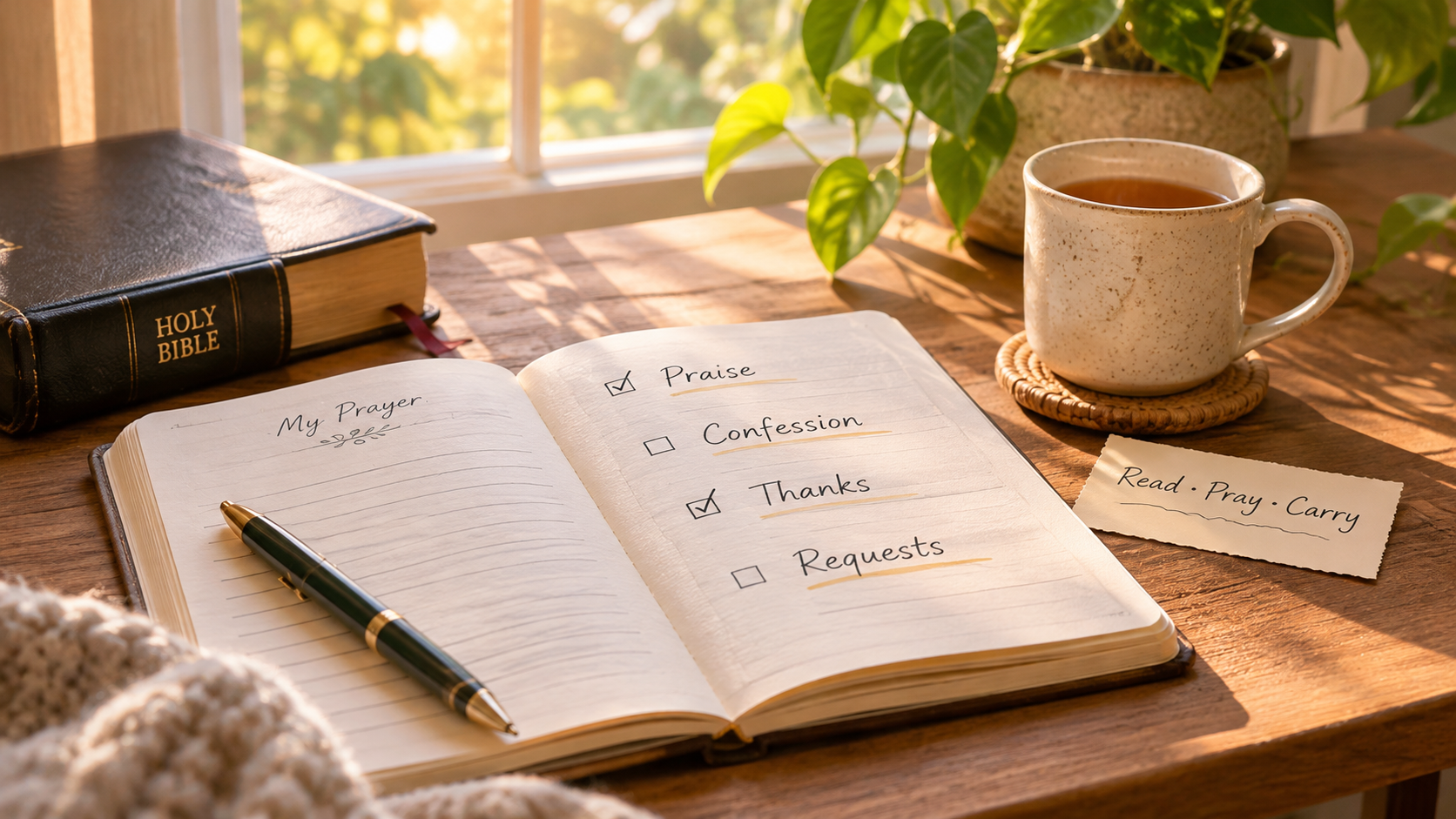

A Bible-first prayer life begins with a simple conviction: God speaks through His Word, and prayer is our response to Him.
That keeps prayer from depending entirely on mood, memory or urgency. You do not have to invent a spiritual experience every morning. You can open Scripture, receive what God has revealed, and answer Him with praise, confession, thanks, questions and requests.
Bible-first prayer is not reading a verse and then forcing every sentence into a formula. It is letting the truth, priorities and promises of Scripture shape the conversation.
Contents
- 1 Begin With God, Not Your Performance
- 2 Let Jesus Set the Priorities
- 3 Read a Small Passage Before You Pray
- 4 Turn What You Read Into an Honest Response
- 5 Pray the Meaning, Not Just the Words
- 6 Bring Your Real Needs to God
- 7 Listen by Staying With Scripture
- 8 Use a Simple Daily Rhythm
- 9 When You Do Not Know What to Pray
- 10 When God’s Answer Is Not What You Expected
- 11 Let Prayer Move Into the Rest of the Day
- 12 A Seven-Day Starting Plan
- 13 Frequently Asked Questions
Begin With God, Not Your Performance
Many new Christians assume that good prayer requires impressive words, a long quiet time or a strong feeling of God’s presence. Jesus warned against praying to be seen and against thinking that many words make prayer more effective (Matthew 6:5–8).
Prayer rests on God’s character, not your eloquence. Hebrews 4:16 invites believers to approach the throne of grace with boldness so that we may receive mercy and find grace to help us in time of need.
You come because Christ has opened the way. You do not earn access by having a perfect week, and you do not lose the right to pray because your words feel ordinary.
Let Jesus Set the Priorities
When the disciples asked Jesus to teach them to pray, He gave a pattern that begins with God’s name, kingdom and will before moving to daily needs, forgiveness and protection (Matthew 6:9–13; Luke 11:1–4).
The Lord’s Prayer gives prayer a healthy order:
- Honor God for who He is.
- Desire His kingdom and will.
- Ask for daily provision.
- Confess sin and receive the call to forgive.
- Ask for protection from temptation and evil.
You can pray those exact words thoughtfully, but you can also use each line as a doorway. “Give us today our daily bread” may lead you to thank God for provision, ask for work, pray for a family in need and surrender tomorrow’s anxiety.
Read a Small Passage Before You Pray
Choose a passage short enough to understand. If you are new to this, start with this step-by-step Bible study guide. A paragraph, a psalm section or several connected verses are usually more helpful than opening at random and isolating one sentence.
Read once for the main idea. Read again and notice what the passage shows about God, people, sin, grace, wisdom or hope. Ask what the author is saying in context before asking what the passage means for you personally.
Then pause. You are not trying to produce a clever insight. You are giving attention to what is actually there.
Psalm 119:18 offers a fitting beginning: “Open my eyes, that I may see wondrous things out of your law.” That is both a request for understanding and a humble admission that we need God’s help.
If you need a passage to begin with, you can read Psalm 23 using BibleGateway.
Turn What You Read Into an Honest Response
Most passages naturally invite one or more kinds of prayer.
Praise
If the passage shows God’s faithfulness, holiness, wisdom, mercy or power, tell Him what you see. Praise is not flattery. It is agreement with the truth about God.
Confession
If the passage exposes an attitude or action, name it without excuse. Psalm 51 shows David appealing to God’s loving kindness, asking for cleansing and seeking a renewed heart. Confession is specific honesty joined to trust in God’s mercy.
Thanksgiving
If the passage shows what God has given or done, thank Him. Gratitude can be concrete: a promise, a correction, daily provision, another believer or the grace to begin again.
Request
Ask God to produce the truth of the passage in your life and in others. If you read about patience, pray for patient obedience in the situation you face today. If you read about God’s care for the vulnerable, pray for a person who needs help and ask what faithful action you should take.
These categories are guides, not boxes you must fill every day. The passage and your real circumstances may emphasize one response more than another.
Pray the Meaning, Not Just the Words
Praying Scripture does not mean taking every sentence as a personal promise. Some passages describe a particular event, speak to a particular person or record words God does not endorse.
Respect the context. Ask what the passage meant in its place in Scripture and how its truth applies under the teaching of Christ.
For example, a psalm of lament may give you language for grief even if your circumstances differ from the writer’s. An apostolic prayer may show priorities worth asking for—wisdom, love, endurance and knowledge of God—even when the people named in the passage lived long ago.
Bring Your Real Needs to God
Bible-first prayer is not less personal. Scripture gives your personal prayers a trustworthy foundation.
Philippians 4:6 says, “In nothing be anxious, but in everything, by prayer and petition with thanksgiving, let your requests be made known to God.” You may bring work, health, family, temptation, fear and practical decisions to Him.
You do not need to hide confusion. The psalms include joy, fear, anger, grief, waiting and hope. Honest prayer brings those feelings under God’s truth rather than treating the feeling itself as the final truth.
Listen by Staying With Scripture
Christians sometimes describe prayer as speaking and listening to God. The safest foundation for listening is the Word God has already given.
After you pray, remain with the passage. Is there a command to obey, a promise to trust, a sin to confess, an example to follow or a person to serve? Write one sentence that captures the next faithful response.
Be cautious about treating every sudden thought as God’s private message. Impressions should never override Scripture, excuse sin or place your preference beyond wise counsel. God’s Spirit does not contradict God’s Word.
Use a Simple Daily Rhythm
A sustainable practice can take ten or fifteen minutes:
| Step | Practice |
|---|---|
| Settle | Put away distractions and ask God for attention. |
| Read | Read one short passage in context. |
| Notice | Write one truth about God and one response the passage invites. |
| Pray | Praise, confess, thank and ask as the passage leads. |
| Carry | Choose one sentence, action or person to remember during the day. |
Keep the practice small enough to repeat. A steady reading rhythm also helps; see why Christians read the Bible daily. Consistency grows more reliably from a clear rhythm than from occasional ambitious sessions.
If you miss a day, begin again. Prayer is a relationship of grace, not a streak you must protect.
When You Do Not Know What to Pray
Romans 8:26 says that the Spirit also helps our weaknesses, because we do not know how to pray as we ought. That is comfort for confused, tired and grieving believers.
When words are difficult, pray a psalm slowly. Use the Lord’s Prayer. Name the person or problem before God. Ask for wisdom, mercy and faithfulness. Silence can also be an honest posture when it is trustful attention rather than an attempt to manufacture an experience.
A very short prayer can be real prayer: “Father, help me believe what I have read and take the next faithful step.”
When God’s Answer Is Not What You Expected
First John 5:14 says that if we ask anything according to God’s will, He hears us. The verse gives confidence in God, not control over Him.
God may answer differently from the outcome we hoped for. He may say yes, no, wait or provide grace to endure. We keep asking honestly while submitting our request to His wisdom, as Jesus did in Gethsemane.
Unanswered prayer can be painful. Do not cover that pain with a slogan. Bring it into the community of faith, keep returning to God’s character and avoid blaming yourself as though a better technique would force an answer.
Let Prayer Move Into the Rest of the Day
Colossians 3:16–17 connects the word of Christ dwelling richly with worship, gratitude and doing everything in Jesus’ name.
Carry the morning’s truth into ordinary moments. Pray before a difficult conversation. Thank God when you notice provision. Confess quickly when you fail. Ask for help before making a decision. Pray for people when you promise you will.
A Bible-first prayer life is not confined to one chair or one time of day. The focused practice trains you to respond to God throughout the day.
A Seven-Day Starting Plan
Use these passages for a first week:
- Day 1: Matthew 6:9–13 — Jesus’ prayer pattern.
- Day 2: Psalm 23 — God’s care and guidance.
- Day 3: Psalm 51:1–12 — confession and renewal.
- Day 4: Philippians 4:4–9 — anxiety, prayer and the mind.
- Day 5: James 1:5–8 — asking for wisdom.
- Day 6: Colossians 3:12–17 — Christ-shaped character and gratitude.
- Day 7: Romans 8:26–39 — the Spirit’s help and God’s faithful love.
Read the whole selected section, notice the context and use the simple daily rhythm. At the end of the week, keep the practice that helped you attend to Scripture and respond honestly.
Frequently Asked Questions
Do I have to pray out loud?
No. Scripture records spoken prayer and inward prayer. Pray in the way that helps you attend honestly, while remembering that praying with other believers is also part of Christian life.
Can I write my prayers?
Yes. Writing can slow your thoughts, help you respond to the passage and show patterns over time. A journal is a tool, not a requirement.
What if prayer feels dry?
Continue with a small, honest practice. Read a psalm, pray the Lord’s Prayer and tell God the truth about your weariness. Dryness does not prove that God has abandoned you or that your prayer is worthless.
Should I wait for an answer before I finish praying?
You may pause and reflect, but do not pressure yourself to produce a message. Return to Scripture, obey what is clear and seek wise counsel for major decisions.